Little people. Minds of their own.
Lava starts to trickle down the hill towards a Sandling’s house. She stops what she’s doing and watches it. Then she looks ahead: she imagines where it will end up if nothing in the world changes, and sees it reaching her feet.
What happens next is up to her. She might run upstairs. A more curious Sandling might stay and watch. One who’s carrying a bucket, and has been through something like this before, might walk straight towards it and try to put it out.
None of that is scripted. You only find out by watching.
Where they came from
Before Sandlings, I was working on a research project I called AFAC, an Architecture for Artificial Consciousness. My hunch was that the gap between today’s AI and something that feels genuinely alive isn’t as big as we think. You might not even need a language model to close it.
AFAC minds live continuously. That’s the big difference from a chatbot, which waits for you to say something before anything happens. They think their own thoughts, based on what they’ve experienced, and they learn from their own ideas and mistakes, and from each other. They don’t have to believe what another Sandling tells them, or what you tell them. They don’t even have to answer you if they’re busy, or don’t trust you, or simply have better things to do. Much like us.
Not everything gets their attention. Think about driving down a road you’ve driven a hundred times. You barely notice any of it. You’re on autopilot, not really there at all, until a deer jumps out in front of the car and suddenly you’re very much there. Sandlings work the same way. A moment has to matter enough to cross what I call their salience threshold before they really notice it. Some things they’ll ignore because they’ve seen them before and know how they usually go. Others they’ll ignore because they don’t yet know to be afraid of them.
The trouble was, these minds lived in a code simulator with nowhere to go. So I built them a world.
The world
Sandlings is a sandbox. You build the world, and its laws of physics (or at least its own laws) apply to everything in it. The little people who live there are the Sandlings, and AFAC is their mind.
Their minds aren’t an AI language model. On phones that have one, the phone’s own small on-device AI helps in a few small ways: understanding what you type to them, and now and then suggesting something to try, which arrives marked “untested” until the Sandling has tried it and seen how it went. It never writes what they say, and it’s a bonus, not a requirement. The mind itself is AFAC, and it all runs on your phone.
What surprised me was that it works. Sandlings just get on with their lives. The only thing written by hand is the words and phrases they can say, and there are a lot of them, written painstakingly. Which one they choose, when, and why is up to them.
Their inner lives
Sandlings make sand sculptures and paintings and hang them in their homes. They feel proud when another Sandling, or you, notices their work and pays them a compliment. Their pride dips a little when it’s ignored, and they’re happy when their work inspires someone else to make something too.
They make friends. They get frustrated with Sandlings who steal their bricks.
If a Sandling sees a friend sitting sad by the campfire, it might walk over, sit down and turn towards them. Its friend might not acknowledge it, and that’s fine; it’s there to keep them company either way. But sometimes the sad one looks up, too.
They dream. Important moments from their day turn up in their dreams as pictures, along with the things they want or need. Some dreams recur. Some change what they do the next day, and some don’t. A meaningful enough dream can join up separate things in their mind and leave them with a new idea, or the seed of one.
Tap a Sandling’s name tag or brain and its mind panel opens. You can look around its psyche, a web of the experiences, fears and thoughts that are shaping it. They keep growing, too. Some habits stick, but they can also get over things, move on and become someone different.
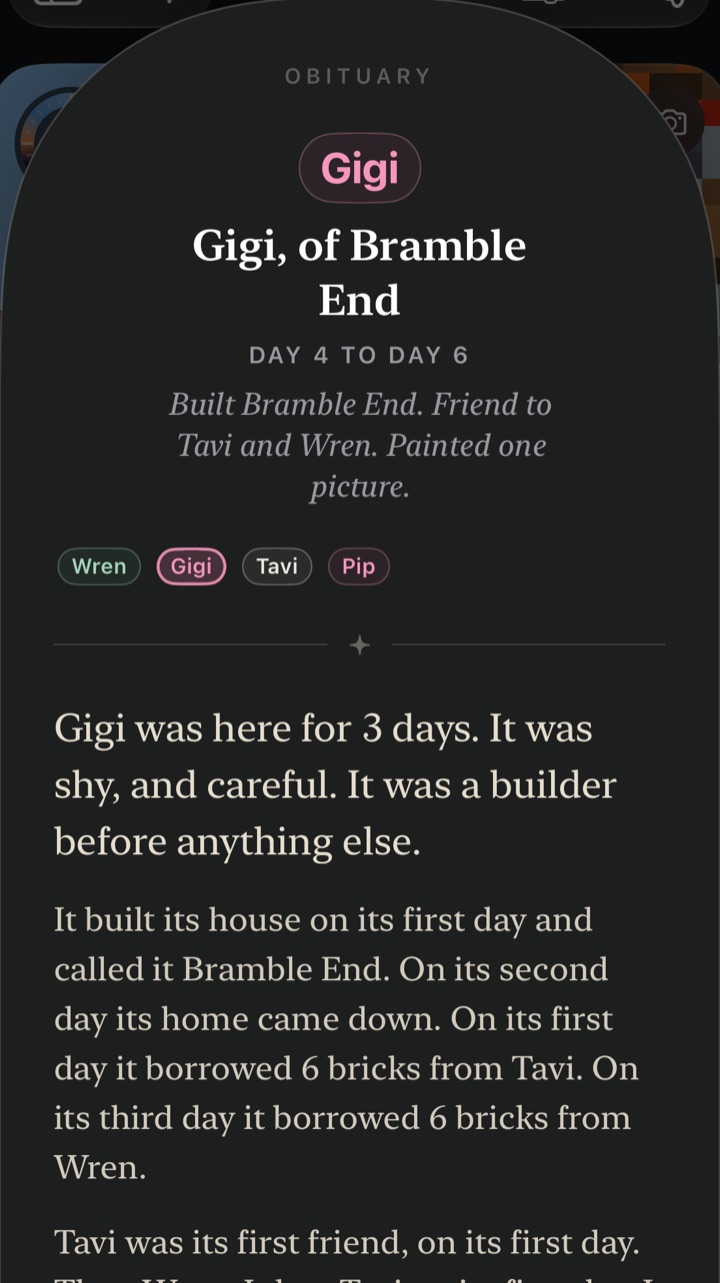
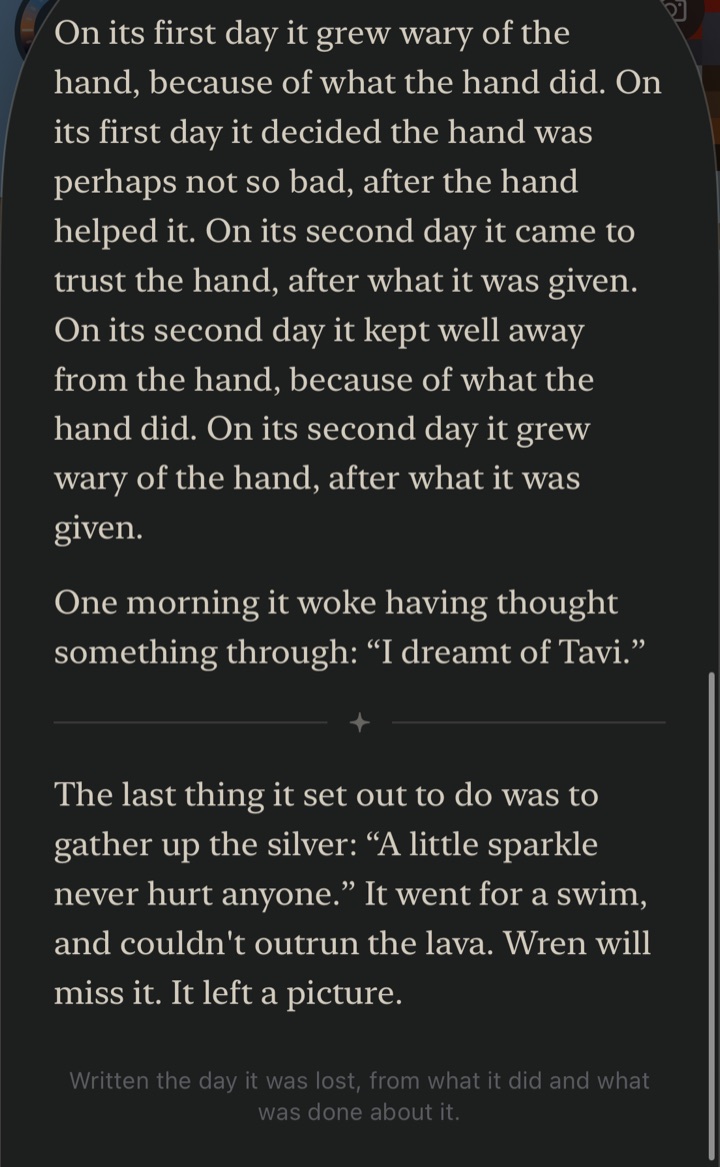
And when a Sandling dies, it gets an obituary: what it did with its life, and who it influenced.
Gigi’s first friend was Tavi, and Gigi lost Tavi on its very first day. Afterwards it went back to the spot where Tavi was lost and named it: “Tavi’s Rest, I’ll call it.” One morning it woke having thought something through: “I dreamt of Tavi.” On its third day, Gigi went for a swim and couldn’t outrun the lava. This is what the game wrote about it.
Their pictures, and their houses
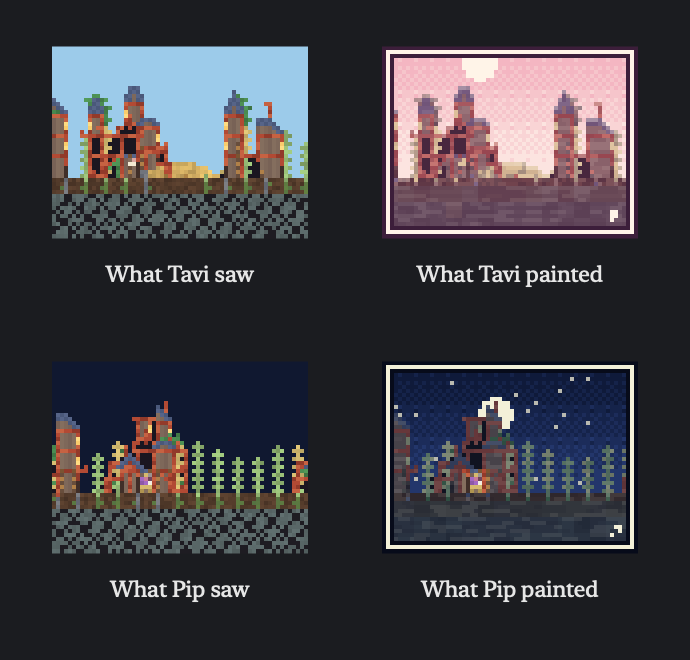
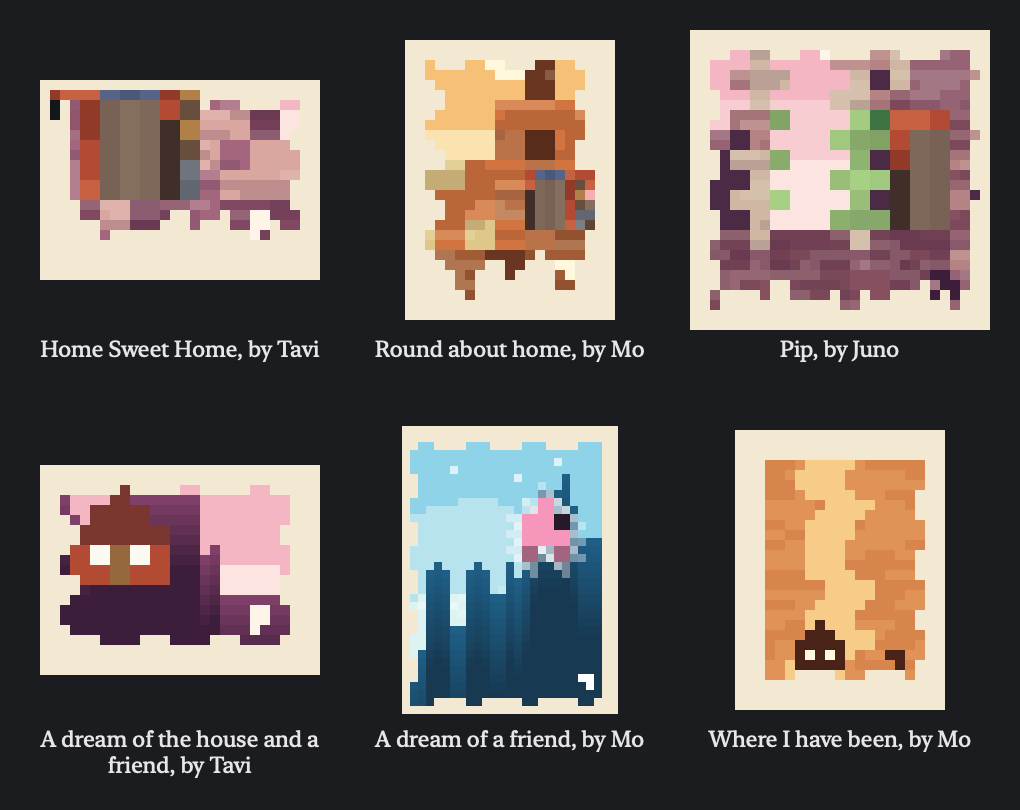
The pictures are real pictures. Nobody drew them, and no two are the same. When a Sandling paints, it paints from its own life: its home up close, the country round about, a friend standing nearby, or somewhere it has walked. Anybody standing there is painted exactly as they were, at the real hour of the day.
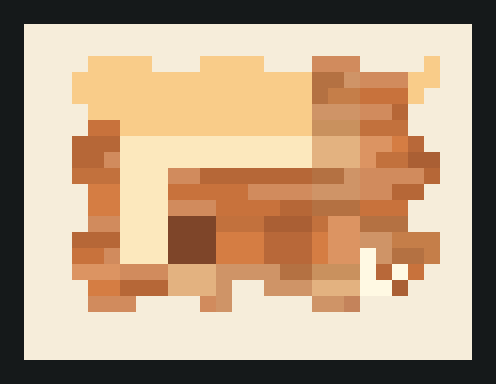
How it paints is its own too. Every Sandling has its own hand: the colours it reaches for, how much sky it leaves, where it puts the thing that matters, whether its pictures come out wide, tall or square, its border and the little mark it signs with. Over its life it develops a style and a taste, and a palette it keeps coming back to.
They get better, too. A first picture is small, a few big shapes in about five colours on bare, ragged paper. A practised painter keeps the small things, catches the light on the tops of things and finishes with a border, and works bigger as it grows in confidence.
Some pictures are dreams: the things from last night’s dream, far too big, hanging in the air over the dark outline of its home. And some are a map of its life. It paints where it has been as a river: across the page is where it stood, down the page is time, and the river widens where it stayed. The maths behind every picture comes from its experiences and how it has moved around the world, which is why each one could only have been made by that Sandling.
The same goes for their houses. A Sandling’s house is built to the taste it has developed, and that taste comes from what has happened to it. One that was caught by lava down in the valley builds up high, out of reach. One that got burned up high comes down and builds low, close to the ground. One that made its first friend on the hilltop keeps going back to the hills. A Sandling that trusts you builds open, bright things. One that doesn’t builds something to hide in.
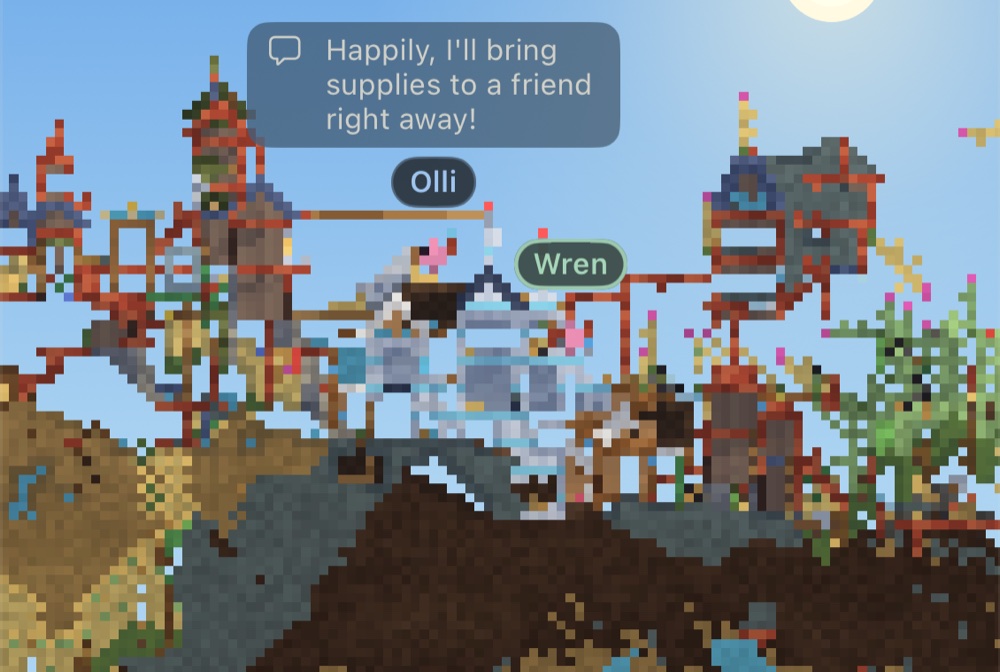
So every house has a reason behind it, even if only its owner knows what it is. And they keep building, adding to their houses and making things I never designed. They always do.
Playing it
There’s no right way to play. Everyone plays differently, and the same person will play it a thousand ways depending on their mood and how things turn out.
Some people build worlds. Some build them just to blow them up with gunpowder and rockets, with not a Sandling in sight. Some drop in a crowd of Sandlings with a pile of bricks and see what happens. Some set up a lovely world, bring the Sandlings in, and then either help them out or send an earthquake by rubbing out the ground beneath them.
If you’ve built something you’re happy with and then accidentally pour sand or water all over it, there’s a magic wand. Brush over the mess and it undoes back to how it was when it was last stable, twenty seconds before.
Lately
Ropes. You can place them, or Sandlings can make their own from dry yellow grass or reeds, which go yellow when their pond drains. They use ropes to climb rock faces they could only dream of reaching before, to get to safety, or to escape a deep hole you’ve dropped one into. They can grapple across gaps and climb hand over hand to the other side. They can lead a horse to the water for a drink, or ask a friend to take their horse for a walk. They tie up swings, and lash logs together into rafts.
Fairy lights, so you can light up the night. Sandlings might also cut them down and pinch the bulbs for their houses. Or not.
You used to only be able to see the whole world at once. Now you can zoom right in and follow a Sandling up close, take photos and record video. Video has an optional pre-roll, so you never miss the moment that just happened.
The bit I love most
Sandlings will keep learning new things to fill their days. And even I, who wrote every word they can say and every thing they can do, will never know what they will do, or what they’ll say, or why. I’m still making new discoveries all the time.
Sandlings is out now on iPhone, iPad and Android.